UART Decoder
Frame Format
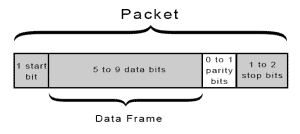
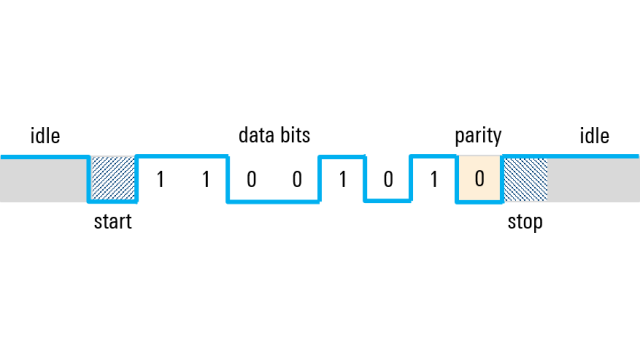
UART transmitted data is organized into packets. Each packet contains 1 start bit, 5 to 9 data bits (depending on the UART), an optional parity bit (can be used to detect single bit errors), and 1 or 2 stop bits:
Decoding in HScope
- Input range: at least 5V
- Sampling rate: at least 100KSa/s for a baud rate up to 19200, 500KSa/s for 112500
- Use the digital module to enable the decoding
Sample of HScope decoded data:
What is UART?
UART stands for universal asynchronous receiver / transmitter and defines a protocol, or set of rules, for exchanging serial data between two devices. Asynchronous means no shared clock, so for UART to work, the same bit or baud rate must be configured on both sides of the connection.
UART is very simple and only uses two wires between transmitter and receiver to transmit and receive in both directions. Both ends also have a ground connection.